
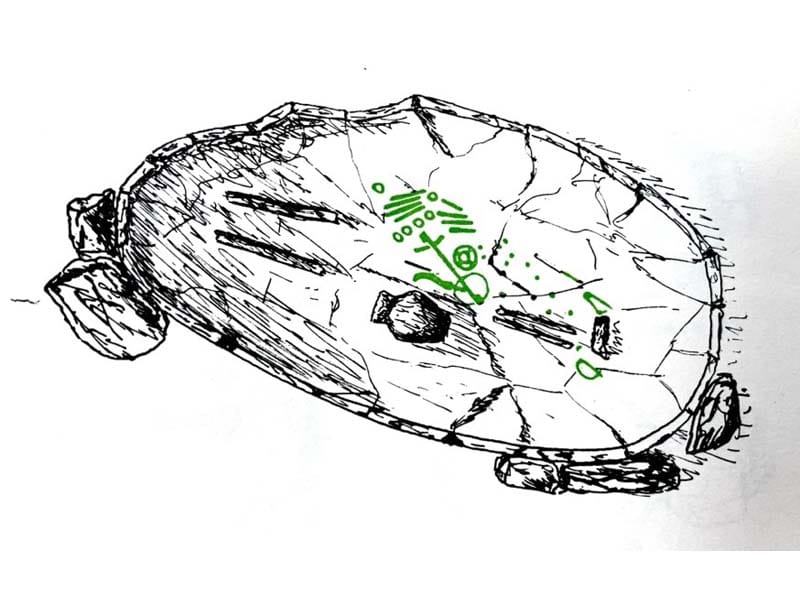
di Barbara Crescimanno
The necropolis of Molino della Badia – Madonna del Piano (Grammichele, Catania), dating back to a period between the end of the Bronze Age and the beginning of the Sicilian Iron Age (11th-9th century BC), differ from the other Sicilian necropolises of the same age. facesBernabò-Brea defines them as one of the most singular and “abnormal” complexes brought to light.
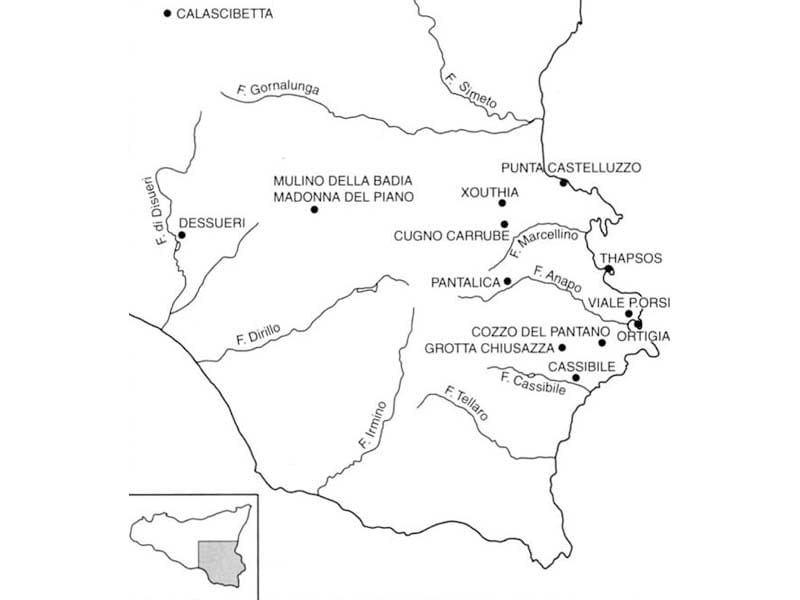
They constitute a "cultural island", first of all for the typology of the funerary rituals which differ from those present in Sicily in this historical phase: that is to say artificial cave tombs usually dug into the rock; in Molino della Badia we find in fact numerous burials enchytrismos, that is, clay situlae or large amphorae containing, often in a curled-up position, infant and adult skeletons respectively, alongside dozens of burials in simple pits dug into the bare earth.
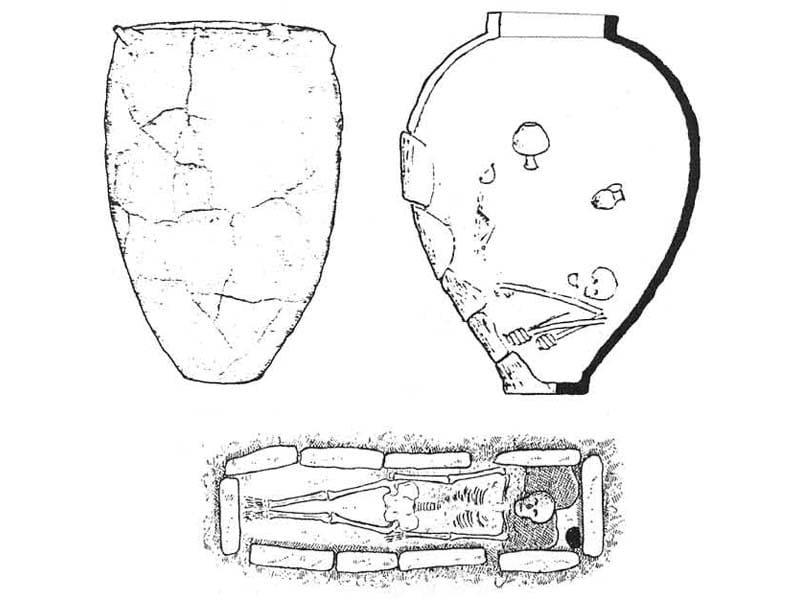
The burial at enchytrismos – that is, within a clay container It is a tradition limited to very few areas in Sicily, and dating back at least to the Early Bronze Age (except for the case of the necropolis of Monte Castellazzo di Marianopoli in Caltanissetta, which dates back to the Middle Copper Age); it is possible to compare the tombs of Grammichele, for example, with those that appear in Milazzo and Lipari (14th-13th century BC). These practices seem to be attributable to Aegean-Anatolian rituals: probably connected "to the identification of the vase with the female body, for which the deceased would be placed in a curled up or fetal position, inside a container that symbolizes the maternal womb” (Albanese Procelli).
According to ancient historiography (Antiochus of Syracuse, Philistus, Thucydides, Diodorus, Strabo), the Bronze Age saw the arrival in Sicily of human groups from the mainland and their consolidation in eastern Sicily and the Aeolian Islands. These events are documented archaeologically by the appearance of necropolises unrelated to local tradition. Indeed, we have no other evidence for supine burials in bare earth in Sicily during this historical period, except at Molino della Badia – Madonna del Piano: this type of grave burial appears to be typical of the cultures of central and southern Italy in the early Iron Age, with the most specific evidence from Calabria. Therefore, there must have been considerable mobility (economic, social, and cultural) between the island and the southern part of the peninsula (and Calabria in particular).
However, Bernabò-Brea's statement arises from the analysis of the grave goods, a notable element of this necropolis.
"The people of Madonna del Piano appear to us as an eminently peaceful people, not belligerent, and very fond of personal ornaments." writes Paolo Orsi in his report. In fact, to date only two tombs in the entire necropolis have been found with a set of weapons, while in almost all the tombs a metal set is attested, especially bronze furnishings, some of which seem to recall further connections with the peninsula, while others instead lead back to faces Sicilian Cassibile and – again – in Lipari.
Among the 350 burials found, several female graves they appear to be particularly rich in funerary equipment (the sexual distinction was deduced from the grave goods; but since no anthropological investigations have been carried out on the skeletal remains to date, this distinction is to be considered subject to future corrections).
The simplest combination found in the tombs includes a fibula, a knife and a spindle whorl: that is, an ornamental object and two work tools; if the spindle whorl easily refers to the female world of spinning and weaving, the knives, Usually found hanging from the belt, these open up several interpretative possibilities. We have several dozen of them in bronze or iron, ranging in size from 12 to 21 cm, in two different types, both without points (therefore not offensive but working tools): "flame-shaped" (originating in the Aegean area) or "olive-leaf-shaped" (typical of the Cassibile period); some examples are of excellent quality and remarkable workmanship, with blades decorated with incised lines or with bone or ivory handles. What were they used for?
We can hypothesize that, found in such a large number of tombs, they were probably linked to shared activities, perhaps carried out in groups, such as the harvesting or processing of edible and/or medicinal plants. On the other hand, the economic and symbolic value attributed to them could suggest a ritual purpose, such as the cutting of the umbilical cord performed at birth by midwives (the two hypotheses are not mutually exclusive). Further studies are needed, however, to answer this question.
More generally, numerous bronze ornaments have been found that make this necropolis – and the people who rested here – an extraordinary place: alongside several dozen fibulae decorated or engraved in various ways, we find small studs, small and large rings, anklets or cylindrical spiral necklaces, earrings, pendants in the form of double spirals, various armillae (metal bracelets), concave-convex disks with a hole in the center, as well as small rods with opposite holes, the use of which is not yet understood.
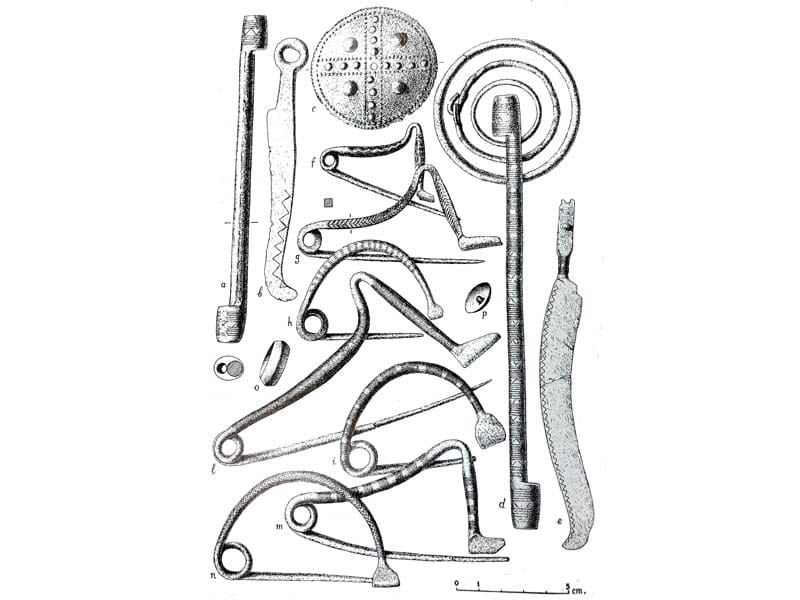
(a, d) small rods with opposite perforated ends, the so-called “rocchetti”; (b) flame knives with eye-shaped handles; (c) concave-convex disk with embossed decoration from T24; (e) flame knife with composite handle; (f, h, l, g, m, i, n) fibulae; (o) finger ring; (p) small stud with internal ring; group of three bracelets (ph. L. Bernabò Brea and others, 1969)
Further enriching the female funerary objects are, of course, objects used for spinning and weaving, which must have been another of the community's main activities: spiral clay spindle whorls, bobbins of various sizes, numerous needles and loom weights, as well as bone and ivory combs and hollow bone cylinders are the objects found in the most richly endowed tombs. One of the richest and most complex funerary objects is found, for example, in tomb 150b, where we also find a bone pin, a precious necklace with amber and glass beads, a zoomorphic pendant in the shape of a bovine and – above all – a strumento musicale.
In fact, in addition to testifying to an evident wealth – probably linked to a specific social rank and a prestigious role – we are interested here in reporting some particular bronze finds in the form of metal breastplates, found in at least one dozen graves of adult women: it is a rudimentary form of chalcophone (i.e. an idiophone – a musical instrument whose sound is produced by vibrating or percussing the material from which it is made – in this case bronze); these instruments, generically called “tintinnabula” (small bells), are made up of tubular bells in the shape of small cylinders or tubes made of metal sheet hanging from a perforated bar and suspended from a chain of bronze rings: they were probably worn as breastplates around the neck by the chain, at one end of which in some cases a small bell was found, in others (in tombs 150b, 197 and 251) a small zoomorphic pendant; these instruments were sometimes found associated with metal rattles and with cylindrical rods of bone or ivory (with a bronze core), perhaps used as strikers of the same instruments; in at least one case, together with a pair of spiral anklets. Some parts of the instrument must have been made of perishable material, as suggested by some fragments of wood or textile fibres found inside the studs or metal coils.
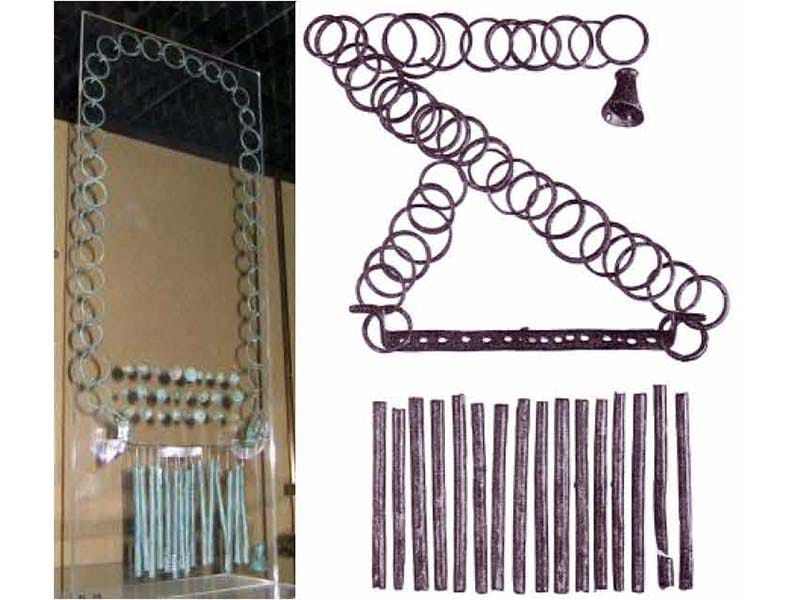
I tintinnabula found in Molino della Badia are dated to the second half of the 10th century BC. Other examples of the same idiophone – in different shapes and typologies – are found in Sicily in Cugno Carrube (Carlentini, Syracuse, 2nd millennium – 9th century BC) and in the Finocchito necropolis (Noto, 730-650 BC); these instruments seem to be the precursors or prototypes of other examples of more elaborate metal instruments coming from different contexts in southern Italy, at least half a century more recent; always belonging to female tombs of high socioeconomic rank and with rich grave goods, they are found for the most part in an area that corresponds to the present-day Basilicata (26 examples) and Calabria (about 20 examples).
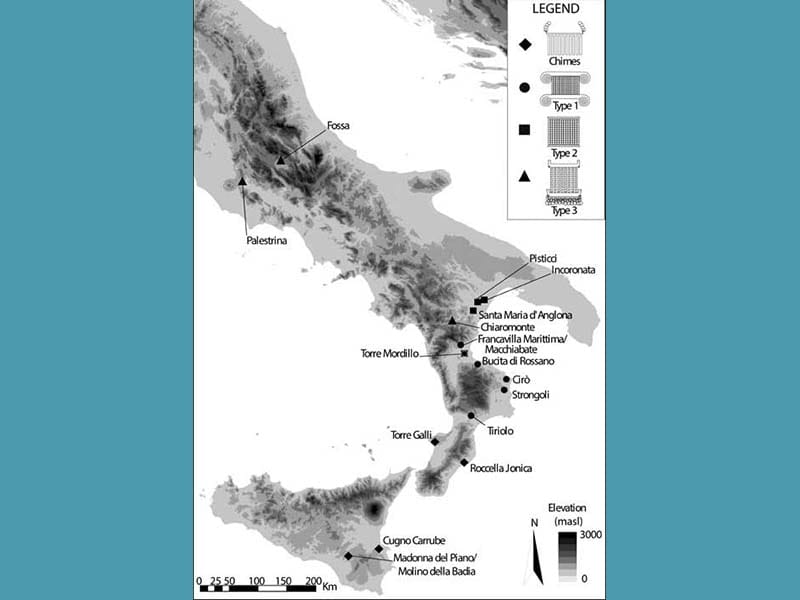
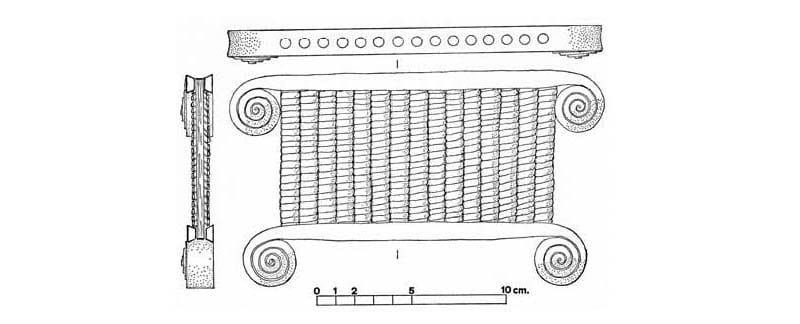
The discovered chalcophones are not all the same: they have different construction models (all with a sound and rhythmic purpose), and were played differently depending on the typology: they could be suspended on the chest, or held in one hand and played with the other; they could be shaken, plucked, or hit against a wooden board to produce sounds. The oldest models, such as the tintinnabula of Molino della Badia, seem to have been designed to produce sounds in association with the body movements of the woman who wore them.
Giulia Saltini Semerari conducted an in-depth study of the various types of metal idiophones found in Italy. She hypothesizes that the chalcophones of southern Italy developed from the simplest prototypes found in Sicily at Molino della Badia; the manufacturing of this type of idiophone may have been modified and refined over time to produce increasingly precise and refined rhythms and sounds.
In what way?
Bronze is an alloy composed primarily of copper enriched with tin in varying percentages—usually up to 8-9%—depending on the desired characteristics. Sometimes copper can also be alloyed with other metals to achieve greater hardness, easier workability, a different color, or other characteristics. Some of the chalcophones found in Sicily are made of cylinders of different sizes, designed to produce sounds of different pitches (like modern wind chimes or cowbells). Archaeometallurgical analyses of the Molino della Badia finds reveal that the metal composing the tintinnabula The tin content is between 11 and 15%, an unusually high percentage for copper-based alloys. The tin content of the finds from the Francavilla Marittima sanctuary deposit (Calabria) is even higher.
As Saltini Semerari points out, “A high percentage of tin in an alloy makes the object more fragile, but also improves its sound, making it louder and more ringing and less dull.”; therefore, those who worked metal between the Bronze Age and the Iron Age possessed high-level skills, which allowed them to calibrate the metallic percentages within an alloy depending on the function the object was intended to have and the sound they wanted to achieve. The appearance of the patina on the finds suggests that the tubes were also carefully polished.
I tintinnabula of Molino della Badia resonate with the simple movement, producing a clear sound. According to Curt Sachs, this type of instrument was created "with the aim of accompanying and giving emphasis to the dance, a complex activity, in which the movements of the head, arms and trunk would have been lost, in a certain way, without an underlining, a corresponding sound".
However, this sound would have been quite chaotic and with a rhythm that was difficult to control; otherwise, locking the cylinders between two bars – as was done in later Italiote chalcophones – could help to better control the sound and rhythm; variants including metal coils or wooden or metal boards or frames could therefore have been developed in the search for both more varied sounds and better control of the movement and rhythm produced.
Other particularly evocative bronze artefacts found in Molino della Badia are some ornaments in the form of spoked wheels, identified (by their position within the inhumations, or by comparison with other funerary contexts in southern Italy) as belt pendants (placed next to the knives); these artefacts in the shape of flat rings (single or concentric) with internal or external crosses have been found in some tombs (as well as in erratic finds), and in at least two cases in association with the tintinnabula; these are objects that seem to have both an ornamental and a sound function at the same time; objects that seem to have been both apotropaic amulets and status symbolThis type of artefact, the vast majority of which were locally produced, has also been found in Cugno Carrube (here too in association with a chalice), in the Finocchito necropolis, in the hoard of S. Cataldo, among the bronzes of the Montagna di Noto (dating between the 9th and 7th centuries BC) and also in contexts relating to later periods, in the Greek-era tombs of the 7th century BC of Megara Hyblea and Syracuse.
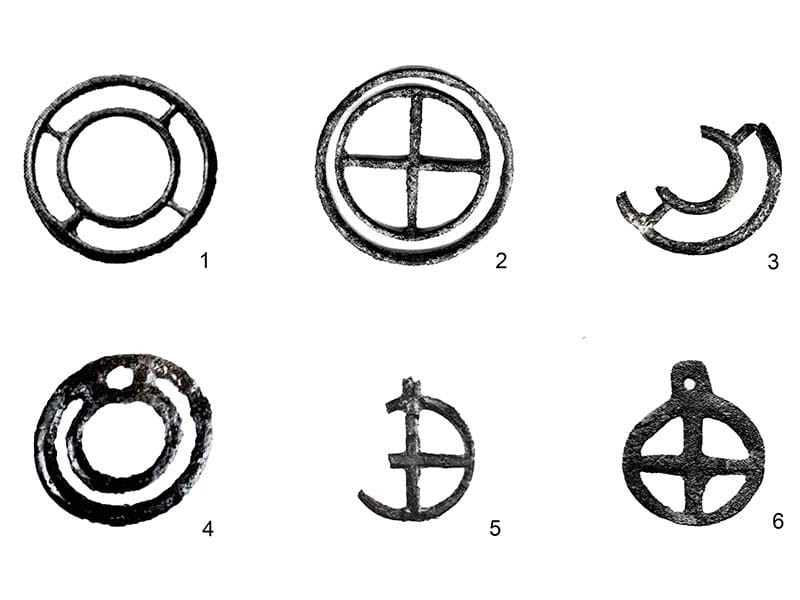
1) Pendant from female burial T6 (diameter 7 cm), found in association with a chalcophone; 2) Pendant from female burial T255 (diam. 7 cm), found in association with a chalcophone; 3) Pendant from the “well tomb” (diam. 6 cm); 4) Erratic find (diam. 6 cm); 5) Erratic find (diam. 4 cm); 6) Pendant from T24 of Cugno Carrube, in association with a chalcophone
“Wheel” belt ornaments have an even higher tin content than tintinnabula, reaching up to 17%: this is the highest percentage found among the artifacts from the Molino della Badia necropolis. Bronze objects of this type, when struck together, emit a crystalline sound; during the Roman period, alloys of this type were used to produce bells and rattles.
I tintinnabula and the belt ornaments therefore represent unique objects due to their metallurgical characteristics; being the artifacts from the necropolis with the highest tin content also made them extremely valuable due to the greater difficulty in obtaining the metal – which in Sicily had to be imported – and its high cost compared to locally produced lead.
Archaeometallurgical analyses show that the bronze craftsmen of Madonna del Piano, where an important workshop undoubtedly existed, were able to empirically control their alloys and made precise choices in their production, deliberately calibrating them to obtain specific characteristics: increasing or decreasing the percentage of tin to obtain specific results (in addition to the sound, also a particular silvery or golden color); or replacing tin with lead when necessary, which in significant quantities darkens the alloy containing it and reduces the brilliance of the metal.
The addition of lead to the alloys used for the cast decoration of elbowed fibulae (replacing the tin widely used in other geographical areas) would appear, for example, to be a highly advanced Sicilian innovation. It allowed, using smaller quantities of the precious tin, to reproduce down to the smallest detail the decoration performed on wax models, while also improving the casting properties of the alloy. Various analyses of artifacts have shown that, in other areas of Italy, the targeted addition of lead to the alloys used for cast parts was introduced at least two or three centuries later than the Sicilian artifacts (Giumlia-Mair).
Giumlia-Mair compares Sicilian wheel pendants with examples from different European contexts, from the peri-Alpine regions and southern Italy. The shapes may vary, sometimes very elaborate, but they are all made of a metal alloy that produces a distinct color and sound. They, too, were almost always found in exceptionally rich female funerary contexts (or in hoards), usually alongside other ceremonial jewelry and other precious grave goods. Peter Turk, who has studied Late Bronze Age hoards in Slovenia, emphasizes the fact that in the various cemeteries studied, only one or at most two graves contain these ornaments. From these indications, he deduces that, over the course of a generation, only one woman in the community wore them. Biba Teržan believes these were individuals who held exceptional importance in the settlements, and suggests that they were responsible for performing special rites or ceremonies for the community to which they belonged. If we follow this hypothesis, how can we interpret the high number (about a dozen) of female tombs with bronze objects found at Molino della Badia in Sicily?
The Calabrian chalcophones found in female burials in the Macchiabate necropolis (Calabria) are musical instruments associated with dance: the development and complexity of the instrument's construction and assembly over time suggests, as we have seen, a growing interest in rhythm control and sound in general. However, already between the Bronze and Iron Ages in Sicily, the quantity and quality of the various "sound objects" found suggests that the women who owned them were musicians and/or dancers at public festivals or ritual ceremonies.
"The complex of objects found [in the tombs of Molino della Badia], some of which were real "sound jewels", contributes to advance the hypothesis that, through movement and dance, these instruments were supposed to make the wearer take on the appearance of a "rattle-woman" (Bella).
Saltini Semerari hypothesizes that these instruments were used by women with a particularly important role, who led rituals and also set the pace for dances, and that this hierarchy could also be reflected beyond their musical role, on a social level. Chalcophones were both a musical and a symbolic instrument: the material expression of such strong social distinction and such a profound relationship between instrument and player that they were buried with their owner, never to be played again by anyone but her.
These women, in this interpretation, may have held priestly roles: the idea that dance was connected to ceremonies is supported by both archaeological and literary sources and by ethnographic examples. We can therefore hypothesize that a select group of women of the elite of Molino della Badia, with its large economic resources, practiced – or guided for the benefit of the community – the production of rhythmic sound during dance, and that dance performances accompanied by rhythmic instruments must have been a key moment in community life.
As Saltini Semerari notes, the best ethnographic parallel for the use of worn metal objects to resonate with movement is the clothing of Siberian shamans and shamans. Among their sound instruments, alongside the drum, are belts and dresses with various metal pendants, and their dance involves rhythmic movement that makes all the metal they wear resonate. It was believed that the metallic sound, combined with the sound of the drum, helped connect with the spirit world.
We cannot draw such a direct parallel between modern Eurasian shamanism and ancient Mediterranean dance rituals: although such a comparison has often been made, we do not yet have sufficient supporting evidence. However, at least based on the material evidence, it can be reasonably argued that the movement required to make a chalcophone or a belt with pendants sound by rhythmically moving the body would not have been too dissimilar from that of Siberian shamans.
Moreover, the "wheel-shaped" objects worn by the women of Molino della Badia must also have been important for their symbolic nature, drawing the attention of those present at the ceremonies in which they were worn to both the physical and auditory presence of the bearer. There is no doubt that these elaborate objects, crafted with extreme care, selecting the most suitable alloys and meticulously finishing each part to achieve a specific color, sound, and shape, possessed a particular meaning and served a ceremonial, ritual, and perhaps apotropaic function.
“In the past, the particular shape of wheel pendants and their archaeological context have led to their being interpreted as both solar and lunar symbols, but their silver colour, the generic connection of silver with water and lunar and fertility cults, and the fact that they were ornaments reserved for the female gender, leans towards the interpretation of the jewel as a lunar symbol and connected with rites relating to fertility and water. [We are induced] It is believed that the beliefs and rituals associated with this particular type of personal ornament were perhaps a widespread cultural heritage not only in the Alpine region, but also in Mediterranean contexts such as Bronze Age Sicily. The use of a silvery bronze, due to the very high percentage of tin, similar to that used for some wheel pendants, in the production of belt pendants of a very similar shape cannot be due to simple chance. Much more archaeological data and analysis will be needed to investigate the significance of this special category of ornaments. (Giumlia-Mair 2014-2015).
If the purpose of the rituals, beliefs and religious practices of Sicily and southern Italy in this period are largely obscure, we certainly cannot help but notice the complex whole, linked to the female world, which emerges from the materials found in the Sicilian, Italian and wider European necropolises: alongside the more usual work tools related to spinning and weaving, the women of these communities used ritual knives, musical instruments and objects of evident symbolic significance: adult women of high rank and great wealth, accompanied by the goods and objects typical of their elite of the Bronze and Iron Ages.
Furthermore, burials with chalices are not only particularly emphatic, but are also—generally—extremely limited, indicating that a very small number of adult women clearly held a prominent role within their communities, as Turk reminds us. It is therefore tempting to hypothesize the existence in the Sicilian necropolis—which preserves such a large number of exceptional burials—of a priestly clique in which such roles were also passed down from generation to generation.Hereditary forms of transmission of goods also seem to be attested at Madonna del Piano by isolated burials of girls or adolescents with 'complex' grave goods, exceptional in the context of the necropolis in which the infant depositions are largely devoid of accompanying objects.” (Albanese Procelli).
For further information see “Necropolis of Molino della Badia – Grammichele (CT)"
References
- Rosa Maria Albanese Procelli – “The necropolis of Madonna del Piano near Grammichele: observations on the funerary ritual” – in Kokalos XXXVIII – pp. 33-68 – 1992;
- Angela Bellia – “Choroplasty with musical depictions of Greek Sicily (6th-3rd century BC)” – in XVII International Congress of Classical Archaeology – Rome 22-26 September 2008;
- Angela Bellia – “Musical instruments and sound objects from the Iron Age in Sicily and southern Italy (9th-7th century BC)” – in Ancient Sicily. An International Journal of Archeology VI – 2009 – p. 9-55;
- Angela Bellia – “Music and Ritual in Sicilian Ceramics. On the Marianopoli Hydriai with Wedding Scenes” – in Phase XII – 2009 – p. 73-82;
- Angela Bellia – Musical instruments and sound objects in Sicily (10th-3rd century BC);
- Luigi Bernabò Brea – Sicily before the Greeks – Il Saggiatore 2016;
- Luigi Bernabò Brea, Elio Militello and Scolastica La Piana – “Mineo (Catania). The so-called Molino della Badia necropolis: new tombs in the Madonna del Piano district” – in Proceedings of the National Academy of Lincei – pp. 210-276 – 1969;
- Massimo Frasca – "The necropolis of Cugno Carrube in the Carlentini territory” – in Excavations in the Necropolis of Leontini (1977-1982) – «Chronicles of Archeology and History of Art» – XXI – 1982 – pp. 11-35;
- Alessandra Giumlia-Mair – “The Metal of the Moon Goddess” – in Arts and Surfaces – Surface Engineering 24 (2) – March 2008 – pp. 110-117;
- Alessandra Giumlia-Mair – “The metallurgy of copper-based alloy finds from the necropolis of Madonna del Piano” – in Proceedings of the Accademia Nazionale dei Lincei – series IX — volume XXV-XXVI – 2014-2015 – Rome 2018;
- Alessandra Giumlia-Mair, Rosa Maria Albanese Procelli and Fulvia Lo Schiavo – “The Metallurgy of the Sicilian Final Bronze Age/Early Iron Age necropolis of Madonna del Piano (Catania, Sicily)” – in Trabajos De Prehistoria 67 – n. 2 – July-December 2010 – pp. 469-488;
- Fabrizio Nicoletti – “Multivariate investigations on the protohistoric necropolis of Madonna del Piano. Chronological serieation of the tombs and analysis of the groups” – in ValdiNoto. Magazine of the Calatina Society of Homeland History and Culture – 1/2006 – Silvio Di Pasquale editor;
- Paolo Orsi – “Necropolis and Sicilian transition stations. Necropolis at Molino della Badia near Grammichele (Catania)” – in Bulletin of Italian Palethnology – XXXI – 1905 – pp. 96-133;
- Dario Palermo – “grammichele” – in Topographical bibliography of Greek colonization in Italy and the Tyrrhenian Islands – n°8 – 1990 – pp. 164-169;
- Curt Sachs – History of musical instruments – Mondadori – 1980 – pp. 6-7;
- Giulia Saltini Semerari – “Calcophones in context. Gender, Ritual and Rhythm in Early Iron Age Southern Italy” – in Mitteilungen des Deutschen Archäologischen Instituts. Römische Abteilung – Band 125 – 2019;
- Biba Teržan – Verovanie in obredi – Bronasta Doba na Slovenskem – Ljubljiana 1987 – pp. 65-78;
- Peter Turk – “The weight of objects in late Bronze age hoards in Slovenia and possibilities for determining weight standards” – in Arheološki vestnik 52 – 2001 – p. 249-279;
- Paola Zancani Montuoro – “Francavilla Marittima Necropolis of Macchiabate. Essays and discoveries in various areas” – in Acts and Memoirs of the Magna Grecia Society – XVIII-XX – 1977-1979 – pp. 7-91.
Barbara Crescimanno 4 October 2026
