
di Elvira Visciòla
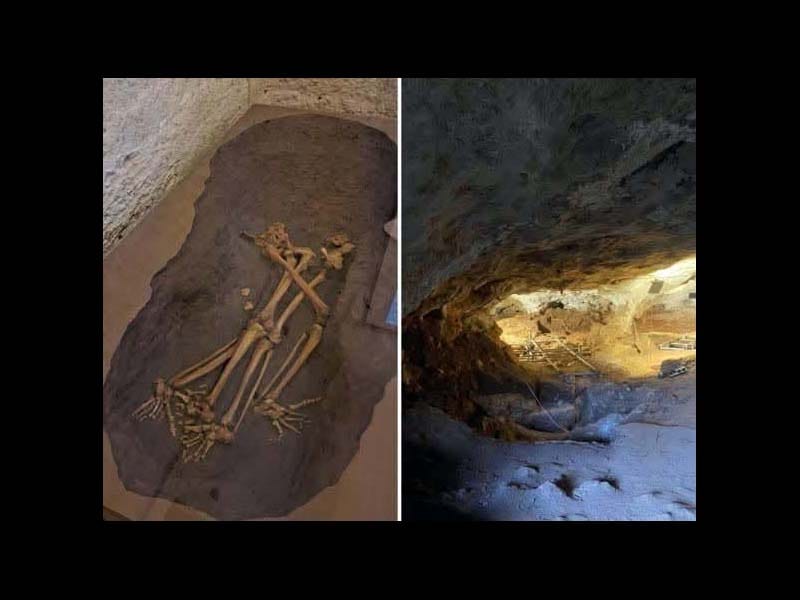
There are archaeological images that seem to speak directly to the present. The two-person burial in the Grotta delle Veneri in Parabita is certainly one of them. Two individuals were placed in the same grave, facing each other, lying on their sides with their lower limbs intertwined. Such a peculiar arrangement has fueled, especially in popular culture, the nickname "Parabita lovers." The image is evocative, but archaeology requires caution.
The Grotta delle Veneri (Venus Cave) is located in the Parabita area of southern Salento and is one of the most important Paleolithic sites in Puglia. The cave's name derives from the famous female bone figurines found in the archaeological deposit, commonly known as "Venuses" (we discuss them here).Parabita figurines (LE)”). The term, now deeply rooted in archaeological dissemination, must be used with an awareness of its interpretative limitations. We do not know what meaning these representations had for the communities that produced them, but their presence in the burial cave along with lithic artifacts, ornamental elements, and decorated objects nevertheless testifies to the richness of the figurative and symbolic production associated with the site.
The cave preserves a long history of successive transformations: the archaeological sequence documents a frequentation that extends from the Middle Paleolithic to the Bronze Age, providing evidence attributable to different periods and activities that have inevitably produced overlaps and alterations, sometimes making the reconstruction of the original contexts complex.
The burial was discovered during excavation campaigns conducted by the University of Pisa between 1966 and 1972. The upper parts of the two skeletons have not survived: the skulls and upper limbs are missing due to the deposition of a Neolithic burial that irreparably damaged the older one. However, the excavation documentation has allowed us to reconstruct the relative position of the preserved remains and, through taphonomic and anatomical analysis, to propose a reconstruction of the bodies' original disposition.
The contribution by Pier Francesco Fabbri, Giorgia Vincenti, and Serena Viva, published in the 2020 volume La Grotta delle Veneri di Parabita (Lecce) (edited by Elettra Ingravallo and Renata Grifoni Cremonesi), is dedicated precisely to the position of the buried and the question of the contemporaneity of the deposition.
This aspect is crucial. The presence of two individuals within the same funerary structure does not necessarily imply that they were buried simultaneously: the same pit may have been used at different times. In the case of Parabita, the particular anatomical relationship between the preserved remains is one of the elements that has led scholars to consider the burial as a single event, with the two individuals within the same pit placed in a precise spatial organization of the bodies. This configuration is particularly important because it allows us to explore the funerary gesture.
The position of the bodies cannot tell us what relationship united the two individuals in life, but we can observe the way in which the community that carried out the burial chose to treat the bodies, maintaining the two individuals in a very close spatial relationship.
One of the most important elements associated with the burial is the set of 26 atrophied deer canine teeth, pierced at the root and characterized by the presence of red ochre. The canines were concentrated in the area near where the heads of the two individuals would have been located and were arranged in a configuration that could be interpreted as the remnants of an ornament.
The arrangement of the teeth has led to the hypothesis that they were originally part of an item of clothing or personal ornament, perhaps a headdress, which subsequently disintegrated following the decomposition of the organic components. Atrophied deer canines are widely documented in European Gravettian contexts and are one of the most recurrent elements of Upper Paleolithic personal adornment. Their use within a burial confirms that these objects were not necessarily simply decorative elements (we discuss them extensively in this article).Amulets of Time. Traces of Proto-Script on Deer Canine Teeth”). An ornament can, in fact, contribute to the construction of individual and social identity. It can indicate belonging, status, role, or simply constitute a significant element of a person's clothing. When placed with the deceased, its meaning can also take on a specifically funerary dimension.
A further element of interest is represented by the red ochre, documented on the canines of the set and in the context of the deposition.
The use of ochre is widely attested in Upper Paleolithic funerary practices and constitutes one of the best-known testimonies of the use of mineral pigments in relation to the deceased.
For a long time, the burial at the Grotta delle Veneri was attributed to the final phases of the Upper Paleolithic, specifically the Early Epigravettian. However, the availability of new chronometric data has allowed us to significantly advance the date. The bones could not be analyzed with the techniques normally used because they lacked the necessary collagen; therefore, scholars examined one of the grave goods, one of 26 deer canines, which places the burial within a period of approximately 28.800–28.300 cal BP, thus within the Gravettian.
This is an important change compared to previous chronological attributions of the burial, as the period is characterised, in much of Europe, by the diffusion of complex funerary practices and the presence of rich ornamental grave goods.
The Grotta delle Veneri fits perfectly into this picture. The female bone figurines, the ornaments made from animal teeth, the stone tools, and the other artifacts found in the cave, along with the use of red ochre, paint a much more complex picture. The presence of the two-person burial reinforces this interpretation.
In fact, we don't just have two bodies buried in a cave. We have a funerary structure, a space in which different practices—funerary, ornamental, figurative, and likely ritual—have converged over the course of human occupation. It is precisely this diversity that makes the site particularly significant, one of the most interesting funerary contexts of the Italian Upper Paleolithic.
The definition of “lovers” is certainly effective from a narrative point of view, an image capable of arousing emotion.
But archaeology can offer something more interesting than a story built on suggestion.
We don't know the names of the two individuals. We don't know their exact ages, their personal histories, or the type of relationship that united them. We don't know whether they were relatives, companions, members of the same community, or people united by a social bond that is impossible to reconstruct today.
We know, however, that about 28.000 years ago, someone prepared a burial and placed two individuals there at the same time, according to a specific method.
We know that the burial was associated with ornaments made of deer canines and that these retained traces of red ochre.
The Grotto of Venus allows us to understand the gesture of those who buried them and, after so many years, that gesture continues to be legible.
Not because it tells us a love story we can demonstrate, but because it testifies to the importance that a Paleolithic community placed on the relationship between two bodies, on the memory of their dead, and on the ritual construction of the funerary space.
It is in this gap between what we can know and what we can only imagine that the burial at Parabita still retains all its strength today.
Bibliography
- Fabbri Pier Francesco, Vincenti Giorgia and Viva Serena – 2020 – “The position of the inhumed and the contemporaneity of the deposition in the Paleolithic burial of the Grotta delle Veneri (Parabita, LE)” – in Elettra Ingravallo and Renata Grifoni Cremonesi (edited by) – The Cave of the Venuses of Parabita (Lecce) – Bibliotheca Archaeologica 58 – Bari – Edipuglia;
- Grifoni Cremonesi Renata – 2020 – “The stratigraphic sequence and the ideological aspects of the Upper Paleolithic” – in Elettra Ingravallo and Renata Grifoni Cremonesi (eds.) – The Cave of the Venuses of Parabita (Lecce) – Bibliotheca Archaeologica 58 – Bari – Edipuglia;
- De Grossi Mazzorin Jacopo – 2020 – “The deer canine tooth set from a Paleolithic burial” – in Elettra Ingravallo and Renata Grifoni Cremonesi (eds.) – The Cave of the Venuses of Parabita (Lecce) – Bibliotheca Archaeologica 58 – Bari – Edipuglia;
- Calcagnile Lucio, Quarta Gianluca and D'Elia Marisa – 2020 – “Radiocarbon dating and provenance analysis of obsidians” – in Elettra Ingravallo and Renata Grifoni Cremonesi (eds.) – The Cave of the Venuses of Parabita (Lecce) – Bibliotheca Archaeologica 58 – Bari – Edipuglia;
- Ingravallo Elettra and Grifoni Cremonesi Renata (edited by) – 2020 – The Cave of the Venuses of Parabita (Lecce) – Bibliotheca Archaeologica 58 – Bari – Edipuglia.
by Elvira Viscòla – 18 September 2026
