
di Elvira Visciòla
In his comic, Ulli Lust tells the story of Stone Age women and challenges one of the most enduring stereotypes in our imagination about prehistory.
Men armed with spears chasing mammoths, hunters wrapped in furs, women gathered around the fire with their children: this is, even today, the image we often associate with prehistory.
An image so familiar it almost seems natural.
Yet it is precisely this supposed "naturalness" that is being questioned by Austrian artist Ulli Lust, who, with her Die Frau als Mensch. Am Anfang der Geschichte (Woman as a Man. At the Beginning of History), chooses to tell the most ancient history of humanity from a different perspective: that of women.
The book, published in Germany in 2025, is a Sachcomic, a comic-documentary constructed through a lengthy engagement with archaeological and anthropological literature. This experiment has received significant recognition: in 2025, Ulli Lust became the first comic book author to win the Deutscher Sachbuchpreis, one of Germany's leading nonfiction awards.
But his work isn't just a book about prehistory. It's also a reflection on how we've constructed our image of prehistory.
The Prehistory We Have Learned to See
For a long time, the narrative of prehistoric societies was dominated by the figure of man: the hunter, the warrior, the tool maker, the leader.
Women, on the other hand, appeared mainly as mothers, gatherers and caretakers of the camp.
Today, this extremely rigid model has been greatly challenged by archaeological research. New methods of analysis have allowed for a more detailed examination of individuals' activities, mobility, diet, social relationships, and roles within communities.
And it is precisely this transformation of research that interests Ulli Lust. In a recent interview published by the magazine Science.orgThe artist emphasizes how, in recent decades, archaeology has profoundly changed many of its interpretative perspectives. The challenge, therefore, is not simply to ask what men and women did in prehistory, but also to understand how our own categories have influenced the way we interpret archaeological evidence.
When images tell the story of women
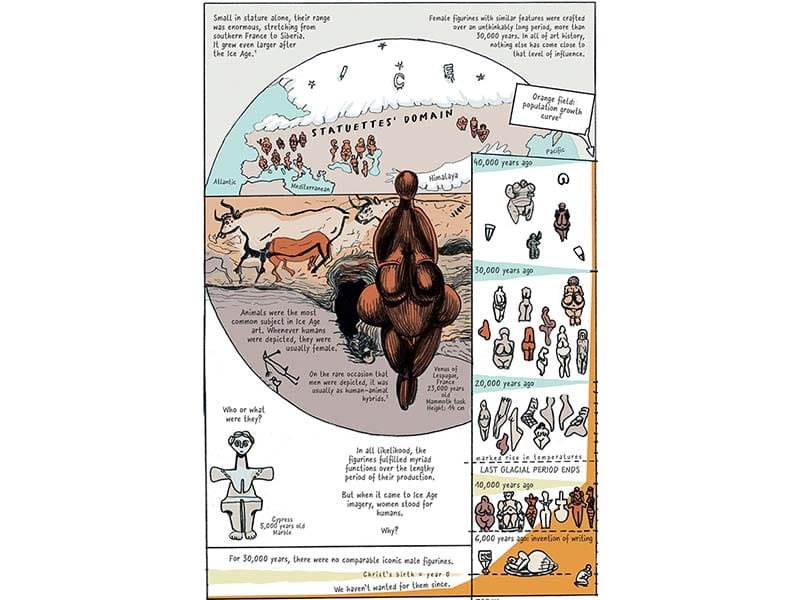
One of the book's central elements is the anthropomorphic representations of the Upper Paleolithic, those that archaeological tradition has often grouped together under the name "Venuses." Their presence is particularly significant because it presents us with a contradiction.
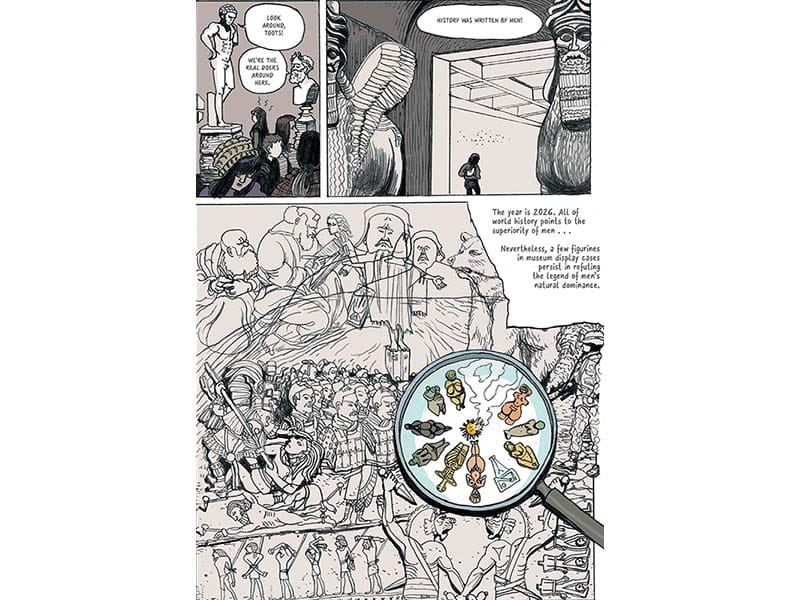
On the one hand, modern imagery continues to depict primarily men engaged in hunting. On the other, a significant portion of Paleolithic anthropomorphic representations depict female bodies.
It is a contradiction that Ulli Lust transforms into the starting point of his research.
The famous female figurines—from the Venus of Willendorf to the Venus of Hohle Fels and the numerous other representations common in Paleolithic Europe—have been the subject of widely varying interpretations throughout the history of scholarship. Fertility, motherhood, sexuality, amulets, deities, and self-representations: these are just some of the hypotheses put forward to explain their meaning.
Lust, however, invites us to ask an even simpler question: why do we so easily tend to explain the female body through fertility?
Her response is provocative. Female figures shouldn't necessarily be interpreted as symbols of motherhood or reproductive capacity. The artist imagines them as "...elderly women, self-confident and independent, without children or partners. They have a strong appearance, as if Ice Age people wanted them to be beautiful..."
It's a fascinating read.
And this is perhaps the most interesting point of his work.
Between archaeology and imagination
Those who study prehistory know how difficult it is to reconstruct a society from fragmentary documentation. An artifact can tell us a lot about the material it was made from, the technique used, its shape, and the context in which it was discovered. It is much more difficult to establish with certainty who made it, who used it, and what meaning was attributed to it.
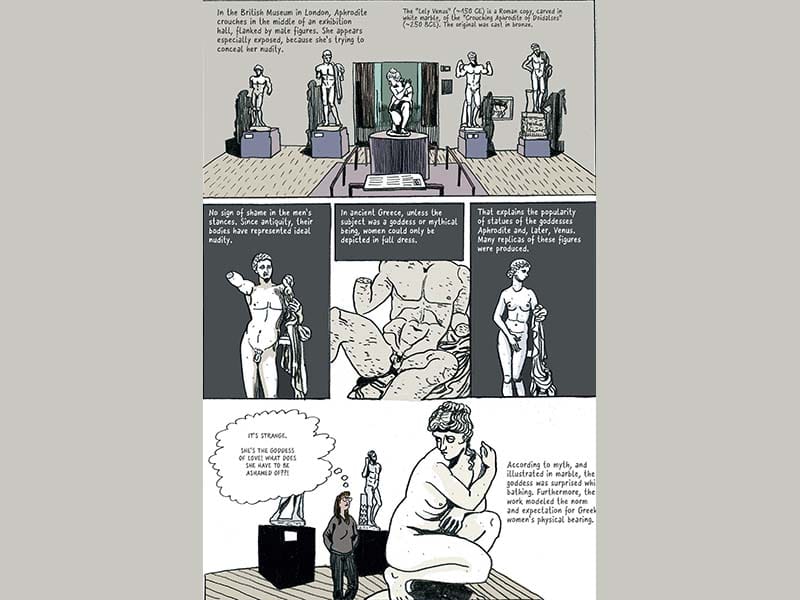
This is where comics come in.
Ulli Lust describes approaching the reconstruction of Paleolithic life as a continuous series of choices. How to dress an individual? How to represent a dwelling? What activities to attribute to men and women? How to reconstruct an everyday gesture for which we have no direct evidence?
For each detail, it is necessary to compare the available evidence and, when this is insufficient, choose the most plausible hypothesis.
The problem is particularly interesting because drawing possesses enormous communicative power: an image can transform a hypothesis into something that, in the reader's eyes, appears as a certainty.
Lust's work thus highlights one of the main responsibilities of archaeological dissemination: distinguishing what we know from what we reconstruct.
The value of a provocation
And this is precisely why Ulli Lust's book is also interesting for those who work in archaeology.
Not because it necessarily provides new answers to the big questions about Paleolithic society, but because it forces us to question the questions we have been asking so far.
Why have we imagined the hunter as a man for so long?
Why should a female figurine with accentuated forms necessarily represent fertility?
And, above all, how much of our images of prehistory actually belong to past societies and how much instead belongs to the contemporary society that produced those images?
These are questions that go beyond the comic.
They concern the very way we do archaeology.
Looking at the past with different eyes
The success of Die Frau als Mensch also demonstrates the public's strong interest in a prehistory different from that found in traditional textbooks. The book was well-received in Germany precisely for its ability to interweave research, narrative, and reflection on the present.
And it is no coincidence that the theme of female images occupies a central position.
Paleolithic figurines continue to challenge us. They are tiny objects, often devoid of a complete archaeological context, separated from the communities that produced them by tens of thousands of years. Yet they continue to generate interpretations, discussions, and even new imaginations.
Perhaps this is precisely their strength.
Ulli Lust reminds us that even the silence of sources can be questioned from different perspectives.
And that, sometimes, to better understand prehistory, it's necessary to change your position before the artifact: "...the very idea of an egalitarian society that doesn't belittle women is a wonderful achievement for many people. We need it..."
Editorial note: The book is in three volumes, and the second volume, Die Frau als Mensch 2: Schamaninnen, was released in Germany in 2026. This week, the first of the three volumes is being released in English translation.
Elvira Viscòla – 10 September 2026
