
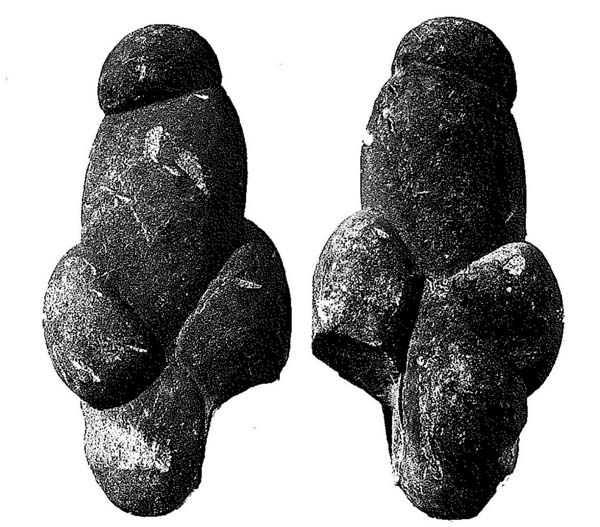
The statuette (ph. G. Baldelli, 1986)
It is difficult to say whether this find is a man-made artifact or rather a natural geological formation with very evocative shapes (such as botroids, for example). It looks like a large sandstone pebble with smooth surfaces: the top cap looks like a sketched head, the deep central furrows seem to outline a pubic triangle on which voluminous masses are grafted laterally, reminiscent of abundant hips. On closer inspection, however, the figure looks more like a sort of mix between a highly schematized female body and a phallic representation. This fusion of the male and female element is reflected in other Paleolithic figurines, such as the Venus of Savignano, the Venus of Trasimeno but also the Venus found in the Weinberg Cave near Mauern, in Bavaria. In these representations, as Gimbutas says, “the phallus is fused with the divine body of the Goddess: far from being an obscene symbol, in ancient Europe its meaning was probably similar to that of the Indian lingam”. Yoni and Lingam, belonging to the most remote Eurasian prehistory, respectively represent the female and male genital organs, symbols of that cosmic duality which structures the different animating forces of the universe, including sexuality. But it is above all their ability to generate life again and again that constitutes their main value. In particular, and it is a comparison that interests our discussion, there is a symbolic variant, the yonilingam, which sees the female and male sex united together: the lingam rises out of the yoni, symbol of the primordial substance, the cosmic matrix of everything the real. It is, therefore, also of the lingam, assimilated to the Pillar of the World around which the rest of the cosmos is gradually ordered. Therefore, this kind of statuettes seem to have a slightly different symbolic meaning than the "classic" Venuses and could symbolize the elevation of the female vital force thanks to the power inherent in the phallus, in a fusion of a cosmogonic matrix.
Historical notes
The pebble is a fortuitous discovery made in 1954 in Fano (PU), near the Ponte della Liscia, at a depth of about five metres.

CARD
LATEST PUBLISHED TEXTS
VISIT THE FACTSHEETS BY OBJECT