

On 1 and 2 December 2026, the Naturhistorisches Museum in Vienna will host Mind over matter – The Materiality of Anthropomorphic Figurines, a workshop organized on the occasion of the hundredth anniversary of the discovery of the Venus II of Willendorf.
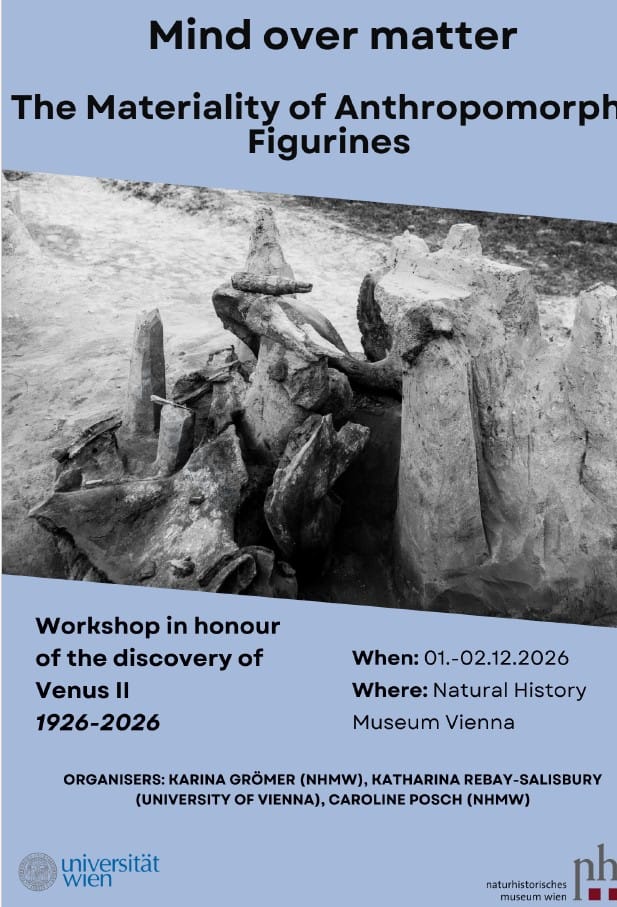
Two days entirely dedicated to prehistoric anthropomorphic figurines, approached from different perspectives: archaeological contexts, materials, production techniques, images, and how these testimonies are interpreted today.
The programme brings together researchers working on some of the most important European Paleolithic contexts, including Hohle Fels, Dolní Věstonice, Galgenberg and Krems-Wachtberg, together with specialists in the processing and use of different materials, from stone to ivory, from clay to bone and horn.
The second day also broadens the scope from a chronological perspective, with talks dedicated to figurines from the Mesolithic to the Metal Ages and a panel dedicated to the relationship between prehistoric figurines and the contemporary perspective.
Looking at the figurines through their materiality
The title of the workshop, Mind over matter, indicates one of the central issues of the meeting.
A figurine is not just an image to be observed and interpreted. It is also a object, made with a specific material and through precise manufacturing techniques.
The choice of material, the gestures required to transform it, the traces left on the surface, and the context in which the object was found can tell part of its story.
It is a particularly interesting perspective because it invites us not to separate what a figurine represents from what we can understand through its very nature as an artefact.
And the Italian stickers?
The program currently does not include a presentation specifically dedicated to Italian prehistoric figurines, and there are no speakers from Italian institutions.
We welcome this fact simply as a characteristic of the current program, without attributing it any sense of exclusion or deficiency. The workshop follows a specific scholarly path, paying particular attention to the large figurative complexes of Central Europe and questions related to the materiality of figurines.
At the same time, we like to think that meetings like this can represent an opportunity to bring together and establish a dialogue between different European research experiences.
Italy preserves a vast collection of prehistoric figurines and anthropomorphic representations, dating from different periods and contexts. Comparing these materials with those from Central and Southeastern Europe could help build an even richer and more detailed picture of the production, circulation, and use of anthropomorphic representations in European prehistory.
Prehistory in Italy She is working on cataloging and conducting comparative studies of prehistoric female figurines found on the Italian peninsula and islands, with the aim of making this heritage more visible and accessible and of promoting its comparison with international research in the future.
We hope that opportunities like the Vienna workshop can contribute to precisely this: to foster an ever-increasing dialogue between research, data, and expertise from diverse fields, because it is through comparison that a broader understanding of European prehistory can emerge.
A dialogue that can still grow
The Vienna workshop brings back to the forefront some questions that have long accompanied the study of prehistoric figurines.
Why were they made? Who made them? What skills and knowledge were required to produce them? Why were certain materials chosen? In what contexts were they used? And how much of our interpretation depends on the findings and how much on how we view prehistory today?
These are questions that do not belong to a single geographical area.
For this reason, it will be interesting to follow the debate in Vienna and observe what new perspectives will emerge from the encounter between different approaches, materials, and contexts.
And it will be equally interesting to continue asking ourselves what place Italian figurines can have within this European dialogue.
It's not a matter of pitting countries or schools of research against each other, but of connecting different heritages. Because only by comparing the various European archaeological realities can we attempt to reconstruct a more complete history of prehistoric figurines.
Prehistory in Italy will follow the Vienna workshop with particular interest and will continue to highlight Italy's heritage, believing that it too can make an important contribution to the international debate.
