
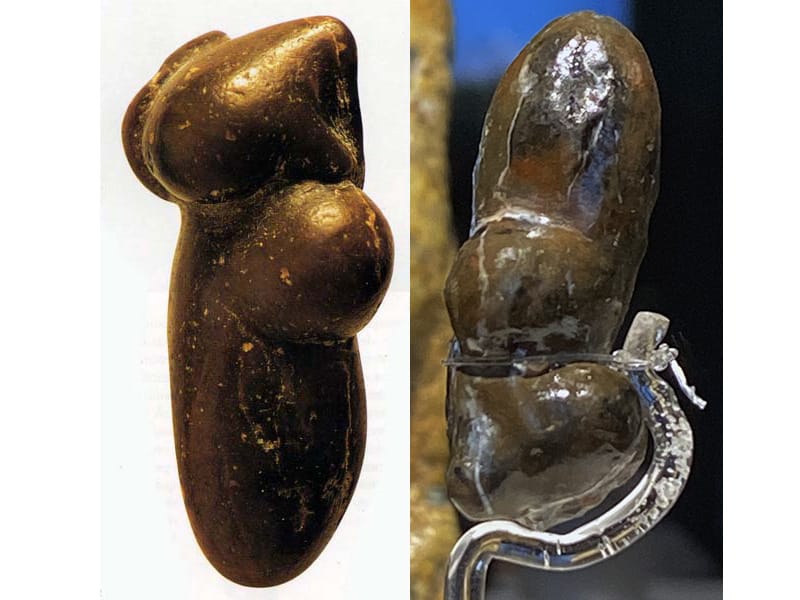
Trasimeno statuette in double position (ph. on the left donsmap.com, on the right E. Visciola, 2022)
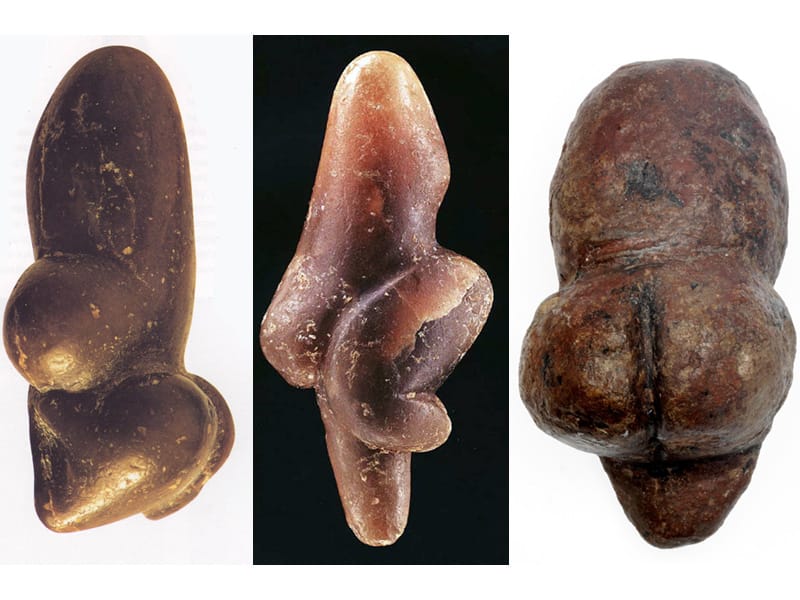
The figurine is made of soft brown steatite with olive-black veins, perfectly smooth and shiny; it was made with the same material as some Balzi Rossi statuettes in Liguria and a drop-shaped pendant with deep lines engraved on both sides found near Castiglion del Lago. Interpreted from the beginning as a female anthropomorphic figure, it lends itself to being read in two different ways, that is, it can be observed in a specific position or upside down. Originally, Professor Paolo Graziosi, consulted for this purpose, discussed the theory already proposed by Abbot Henri Breuil that it was a “calembour”, a sort of “play on words” expertly executed to be observed in both positions and, given its fragmentary nature, it was not possible to establish a univocal interpretation.
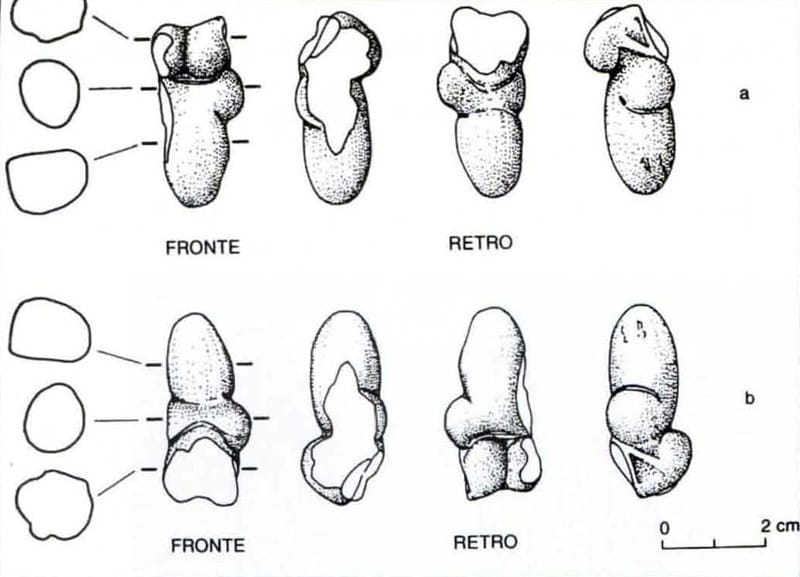
In the first interpretation, the figurine is complete in the upper part with the neck and head fused into a conical appendage, similar to other Paleolithic ones (such as the statuette of Savignano in the Italian context or of Tursac in France and of Mauern in Germany), while it is missing in the lower part from the height of the belly down due to an ancient fracture; the buttocks are prominent, divided by a deep furrow and stretched upwards while at the height of the chest there is a single breast shifted towards one side. The shape of the back joined to the neck and the head gives the statuette a phallic shape associated with the female representation while the position of the breast, too shifted with respect to the axis of the body, creates a sort of hybrid image, without a precise adherence to anatomical reality.
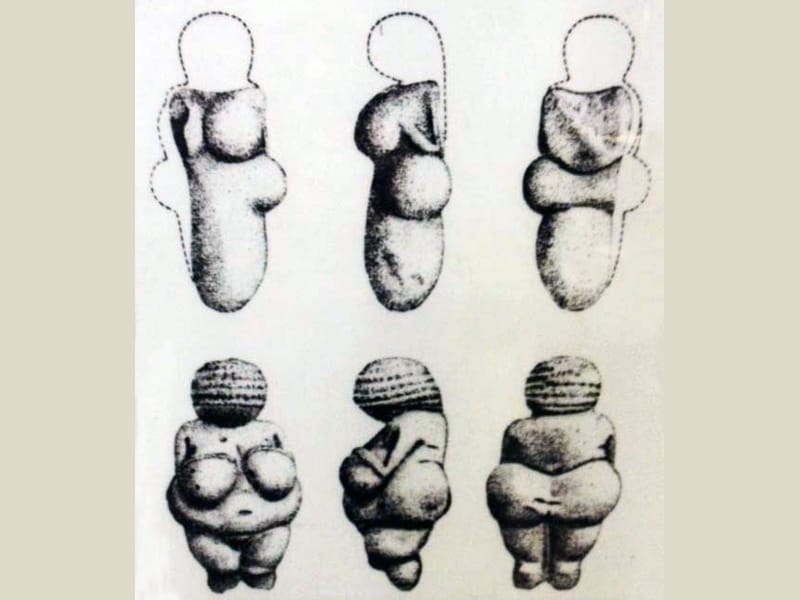
On the contrary, the second interpretation, which to date represents the most plausible vision, foresees that the figurine is without head and neck, with the chest on which emerge the two prominent breasts divided by a deep furrow (corresponding to the buttocks in the previous position) of which one is fragmentary and the legs in a single conical protuberance; laterally to the breast, the protrusion that in the previous position represented the only breast moved to one side, in this vision seems to represent a thin arm crossed on the chest, as often appears in other Paleolithic figurines, such as some geometric and abstract ones found in Russian sites or like the one in ivory from Lespugue.
This latter interpretation was also strongly supported by the paleontologist Alberto Carlo Blanc, who saw important stylistic analogies with the Willendorf statuette.
The question of giving life to new figures through a double rotation of the piece is often found in the Paleolithic context, but what is not yet clear is whether the ambiguity of the representation is dependent on the functional use for ritual practices or derives from an intentional process linked to the telling of myths.
The style of representation of the figurine, a mix between realism and schematism, makes its inclusion in the Gravettian repertoire plausible; however, determining a more precise chronology is very difficult in the absence of precise indications on the context of provenance. One last thing should be highlighted regarding the place where the figurine was found: the area has been frequented since the Middle-Upper Paleolithic but with little evidence, while greater presences are attested from the Neolithic up to the entire Bronze Age and beyond with the discovery of the first settlements. For this reason, it has been hypothesized that during the entire Paleolithic, small groups of hunter-gatherers moved periodically across this territory, probably in search of specific resources or to use the lake for symbolic-ritual purposes.
Historical notes
The figurine was purchased in 1938 by Count Alerino Palma di Cesnola together with other archaeological material collected by Mr. Vincenzo Funghini of Arezzo, a collector of prehistoric material; all the finds were contained in a box bearing the words “from Castelsecco”, the name of the ancient necropolis of Arezzo, and were related to the research he carried out at the end of the 800th century in various locations in Tuscany. The box contained about a hundred pieces, partly Mousterian, partly Neolithic and beyond, and some points attributable to the Upper Paleolithic; among these was also the figurine that appeared as a small stone with a strange shape and that was soon recognized as a Paleolithic figurine. Luigi Cardini, the paleontologist who assisted Count Palma di Cesnola in bibliographic research, understood that the mixture of shapes and finds so chronologically different is common in open-air stations and that they probably came from several areas; analyzing old reports of Mr. Funghini he learned that he had found only 4 Neolithic pieces and a shark tooth in the Castelsecco site, while he reported the discovery of an abundant surface industry from Lake Trasimeno, in particular in the area to the west of the lake within a radius of about 15 km from the current shore, which is why the hypothesis was put forward that the statuette "probably" came from that area.

CARD
LATEST PUBLISHED TEXTS
VISIT THE FACTSHEETS BY OBJECT